


Table of Contents
Introduction
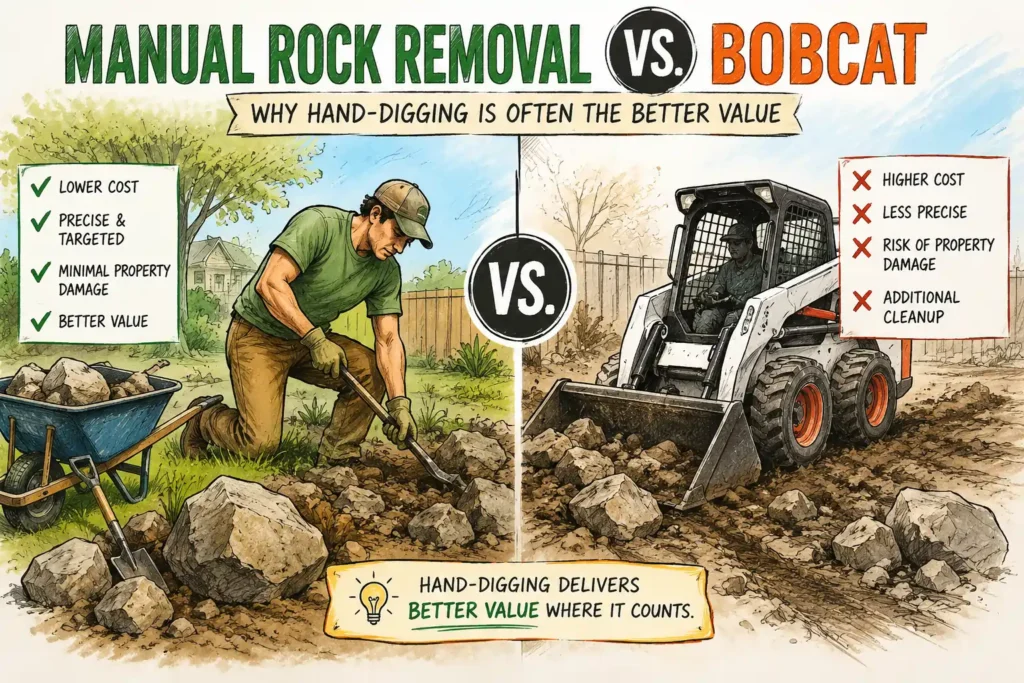
When homeowners decide to remove landscape rock from their property, one of the first questions they face is whether to hire a crew for manual rock removal or bring in a Bobcat for the job. At first glance, heavy equipment seems like the obvious choice. After all, a Bobcat can move large amounts of rock much faster than a crew working by hand. However, speed is only one factor to consider when evaluating the true value of a rock removal project.
In many residential settings, hand-digging can actually provide better results and lower overall costs than mechanical removal. Factors such as accessibility, landscape preservation, soil protection, and cleanup requirements often make manual rock removal the smarter investment. Understanding the pros and cons of each method helps homeowners make a more informed decision. The right choice often depends on the property’s layout, budget, and long-term landscaping goals. If you’re still evaluating whether landscape rock removal is the right investment, our article on 7 Reasons Why Homeowners Should Get Rid of Landscape Rock explains the common maintenance, drainage, and landscaping challenges that lead many homeowners to replace decorative stone.
Understanding the Two Rock Removal Methods
Landscape rock removal is typically performed using either manual labor or heavy equipment such as a Bobcat or skid steer. Manual removal involves workers using shovels, rakes, wheelbarrows, and other hand tools to carefully collect and remove decorative stone.
Bobcat removal relies on machinery to scoop, scrape, and transport rock quickly across larger areas. While both approaches can be effective, the best choice depends on the size of the project, the layout of the property, and the desired outcome. If your project involves decorative river rock rather than standard landscape stone, our Ultimate Guide to River Rock Removal provides additional techniques and considerations that can help simplify the removal process.
Why Many Homeowners Assume a Bobcat Is Cheaper
Many homeowners automatically assume that a Bobcat is the most affordable option because it can complete the physical removal process much faster than a hand-digging crew. While equipment can reduce labor hours, it also introduces additional expenses such as transportation, fuel, equipment rental, operator costs, and potential property repairs. In some situations, the total cost of using heavy machinery can exceed the savings generated by faster excavation, making manual removal a surprisingly competitive alternative. While many homeowners assume equipment automatically lowers costs, the total expense often depends on factors such as accessibility, labor requirements, disposal fees, and site conditions. For a detailed breakdown of current pricing, see our Price Guide for Landscape Rock Removal: Average Costs in 2026 to better understand what influences the final project cost.
The Accessibility Challenge
One of the biggest limitations of using a Bobcat is property access. Residential properties often include narrow side yards, gates, fences, retaining walls, patios, decks, and mature landscaping that limit equipment access. In some cases, machinery can still reach the work area. However, maneuvering through tight spaces may require removing sections of fencing or landscaping before work begins.
Manual rock removal eliminates these concerns because workers can access virtually any part of the property without needing large entry points. Hand-digging crews can navigate tight spaces, work around obstacles, and remove rock from areas that would be impossible for a Bobcat to reach. For many homeowners, this flexibility alone makes manual removal the preferred option.
Protecting Existing Landscaping
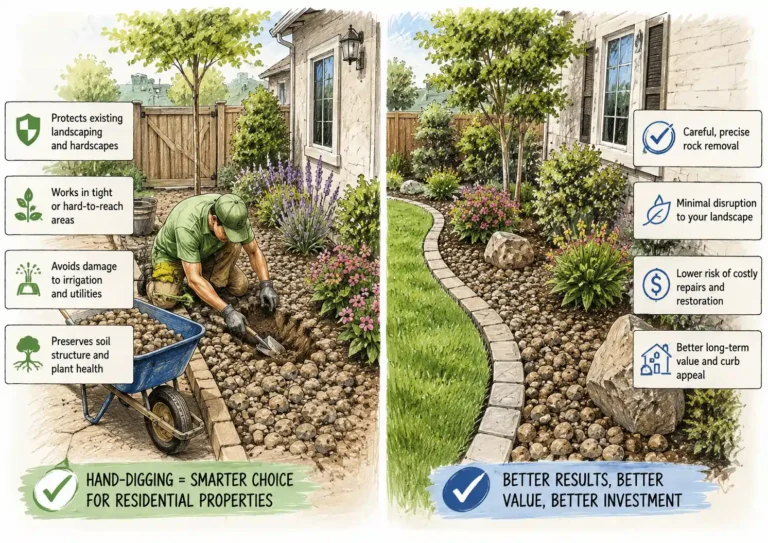
Established landscapes often contain valuable features such as flower beds, shrubs, trees, irrigation systems, paver walkways, and decorative borders. Heavy equipment can unintentionally damage these features during the removal process. Tire tracks, broken branches, crushed plants, and disturbed hardscaping are common concerns when machinery is used in residential environments. Manual rock removal allows workers to carefully navigate around these elements and remove stone without causing unnecessary disruption, helping preserve the appearance and value of the existing landscape.
Reduced Soil Compaction
Soil compaction is another issue homeowners often overlook. Bobcats and skid steers can weigh several thousand pounds, placing significant pressure on lawns and planting areas.
As the equipment moves across the property, it compresses the soil beneath it. This can reduce airflow, limit water infiltration, and restrict root growth. Hand-digging avoids these problems and helps maintain healthier soil for future landscaping projects.
Better Precision During Removal
Not every landscape rock removal project involves clearing an entire yard. Many homeowners simply want to remove rock from specific flower beds, tree rings, or decorative borders while preserving surrounding features. Manual removal provides a level of precision that heavy equipment cannot always achieve. Workers can selectively remove stone without disturbing adjacent soil or landscaping, making hand-digging particularly beneficial for projects that require attention to detail and careful site preservation.
Disposal and Cleanup Considerations
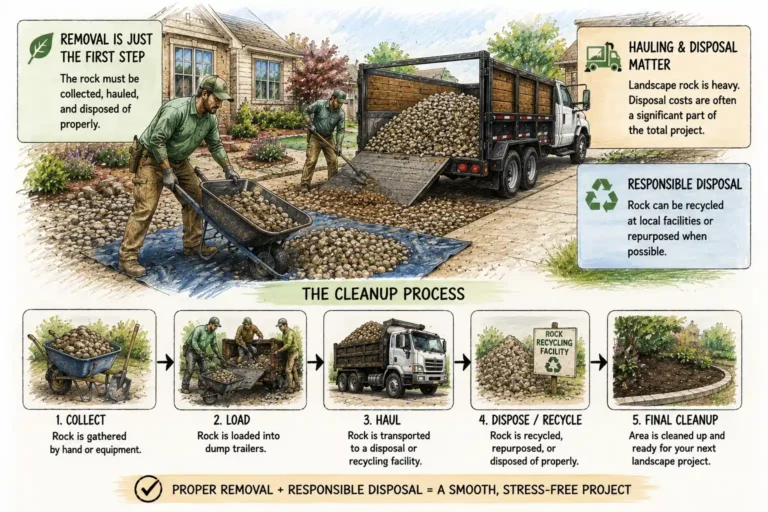
Removing the rock itself is only part of the project. The material must also be loaded, transported, and disposed of properly. Landscape rock is extremely heavy, and disposal costs often represent a significant portion of the overall project budget.
Whether the rock is removed by hand or with a Bobcat, homeowners typically face similar hauling and disposal expenses. Because these costs remain relatively consistent between methods, it is important to evaluate the total project cost rather than focusing solely on excavation speed. Homeowners looking to reduce disposal costs may also benefit from exploring alternative solutions for unwanted stone. Our guide on How to Dispose of Rocks and Gravel: 5 Creative Solutions covers several practical ways to recycle, repurpose, or responsibly dispose of landscape rock after removal.
When a Bobcat Makes Sense
Although manual rock removal offers many advantages, there are situations where a Bobcat is the better choice. Large commercial properties, undeveloped lots, and open landscapes with easy equipment access often benefit from mechanical removal. When thousands of square feet of rock need to be removed and there are few obstacles to navigate, a Bobcat can significantly reduce project timelines and improve efficiency. Equipment may also be beneficial when grading, excavation, or additional earthmoving work is required after the rock has been removed.
When Hand-Digging Provides Better Value
For many residential properties, manual rock removal delivers better overall value. Homes with limited access, established landscaping, irrigation systems, and delicate hardscaping often benefit from the precision and flexibility of hand-digging. The ability to work carefully around existing features can prevent costly repairs and preserve the overall appearance of the property throughout the project.
In addition, homeowners frequently discover that avoiding lawn damage, soil compaction, and landscape restoration costs offsets much of the labor expense associated with manual removal. When the full scope of the project is considered, hand-digging often proves to be the more economical and practical solution despite requiring more physical effort.
Choosing the Right Method for Your Property
Every landscape rock removal project is unique. Factors such as property size, accessibility, landscaping complexity, future planting plans, and budget all play important roles in determining the best removal method. Rather than automatically choosing the fastest option, homeowners should evaluate the complete project and consider the potential impact on their property. Consulting with an experienced rock removal contractor can help identify the most efficient and cost-effective approach based on site-specific conditions.
Conclusion
While Bobcats and skid steers can remove landscape rock quickly, speed alone does not determine the best value. Accessibility issues, landscape damage, soil compaction, and restoration costs can significantly affect the total cost of a project. In many residential settings, manual rock removal provides greater precision, better property protection, and a more controlled removal process that ultimately delivers superior results.
Before choosing a removal method, evaluate your property’s layout, landscaping features, and future plans. It’s also important to consider the total cost of the project rather than focusing solely on removal speed. For properties with limited access or valuable landscaping features, hand-digging often offers the best balance of efficiency, quality, and long-term value, making it a smart investment for successful landscape transformation. For more detailed information, visit our page on rock removal. For support on your next rock removal project, please feel free to reach out through our contact form, and our team will be happy to help.