- Cities
- /
- North Chicago
- /
- Glenview
- /
- Landscaping
- /
- Digging
His Workmanship matches residential homeowners with service providers who offer hole digging and trenching labor. You call the utility company to make sure the cable lines are marked and the crew will bring trench shovels. Rates start at $110 per hour for 2 diggers. New customers can read Ephesians 2:1-10 to receive a $20 discount. Details are on the final step of the contact form.
Speedy Replies
Prompt email correspondence.
Multiple responses daily.
Last Minute Help
Book today and get help
as early as tomorrow.
Upfront Pricing
No hidden fees.
Fixed hourly rates.
Honest and hardworking college students ready to help with digging trenches
Do you need a trench dug to bury wire underground? What about grading dirt away from the house for water drainage? No problem! His Workmanship’s network of landscapers can accomplish any of these digging projects for you. Just say where to dig and how deep to dig and the crew get it done for you. Watch the video below for a closer look at how the digging process works.
His Workmanship coordinates landscaping help in Glenview
Our service providers have your landscaping project taken care of anywhere in Glenview. Check out the map below to view our service area in Glenview. The yard waste is dumped at Midwest Compost which is north of Spaulding Road or at any of the Lakeshore Recycling Systems locations in North Chicago.
Chicago landscaping statistics
Active Students
Average Hourly Rate
$
Happy Customers
1. Get a free estimate in just a couple minutes
Select the services that best align with your needs and describe the details of your project to help us get a better idea of the scope of work. Feel free to upload pictures so your crew can visualize your specific needs.
2. Receive great customer support along the way
Our staff guarantees a reply to all emails within 24 hours. Once you get scheduled, you'll get a confirmation email with your service provider names as well as a text notification 1 hour before your project starts.
3. Relax while we speedily complete your project
Equipment in hand, your crew will arrive a few minutes early so they can collaborate with you about the work that needs to be done. Once they finish, you can pay the total bill directly to the crew leader. It's as simple as that!
Hear what a customer says
“This is the third time I have used His Workmanship. What made His Workmanship catch my eye is the Christian mission. I’ve had the crew out here to do a fairly large project for a new rosebed and they’ve been very hard workers and made the job a breeze. I would definitely recommend His Workmanship for landscaping projects.” – Mark



Ready to inquire about digging labor in Chicago?
Frequently Asked Questions
Manual digging and trenching labor is billed at a simple hourly rate of $60 per hour per worker. The overall cost depends on trench length, depth, width, and soil conditions. Loose, sandy soil progresses quickly, whereas compacted clay, rocky terrain, or heavy tree roots require more time. On average, a standard residential trench (such as for a French drain or utility pipe) takes a 2-person crew 3 to 4 labor hours ($360–$480). Hourly billing ensures you pay only for the exact labor time spent digging.
Improper ground slope toward a home’s foundation is a primary cause of basement water seepage. To fix grading issues, add topsoil along the foundation wall and smooth it so the dirt slopes downward and away from the home. Keep at least 3 inches of foundation exposed below siding to prevent wood rot and pest entry. If regrading alone does not redirect runoff, hand-digging a shallow drainage ditch or French drain system provides a direct pathway for excess water.
It depends on the size and location of the project. Heavy excavation contractors use large skid-steers or backhoes for major building foundations or land clearing, but they carry high minimum fees and can damage established lawns. For smaller, precise residential jobs—such as French drains, garden bed edging, window well clearing, or utility conduit—hiring hand-digging labor using spade and trenching shovels is far more cost-effective and protects surrounding turf.
Heavy machinery is ideal for large-scale demolition or deep structural excavation where speed over a vast area is required. However, hand digging using shovels, trenching spades, and pickaxes is superior for precision work in tight yard spaces. Hand digging prevents massive lawn damage, avoids crushing buried sprinkler lines, and allows workers to carefully navigate around delicate plant roots and existing landscaping.
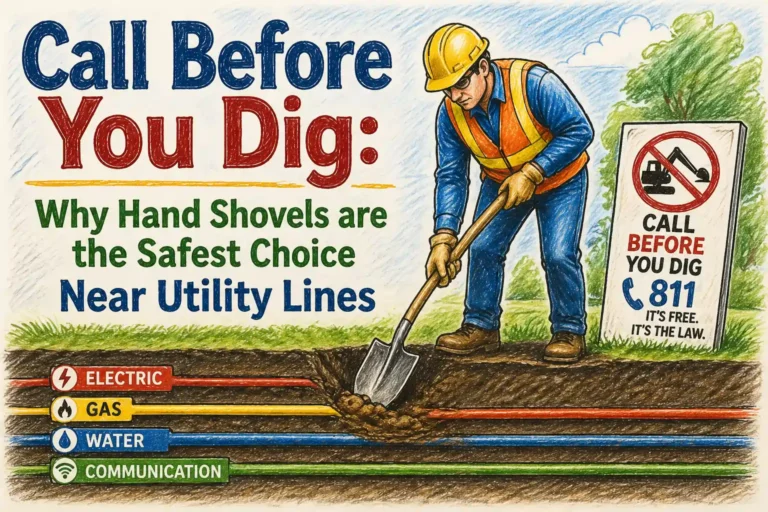
Always call 811 (the free national underground utility locate service) at least 3 business days before starting any digging project. Utility technicians will visit your property to mark buried electric, gas, water, and communication lines with color-coded spray paint and flags. Hand-digging crews can then carefully work around these marked zones to avoid dangerous and costly utility strikes.
Efficient hand trenching relies on using the proper hand tools and technique. Essential tools include a sharp spade shovel for breaking top turf, a narrow trenching shovel for clearing loose dirt from the channel, and a pickaxe for breaking hard clay. Diggers use body weight on the shovel shoulder rather than lower back strain, clearing roots cleanly as they work along a marked chalk or string line.
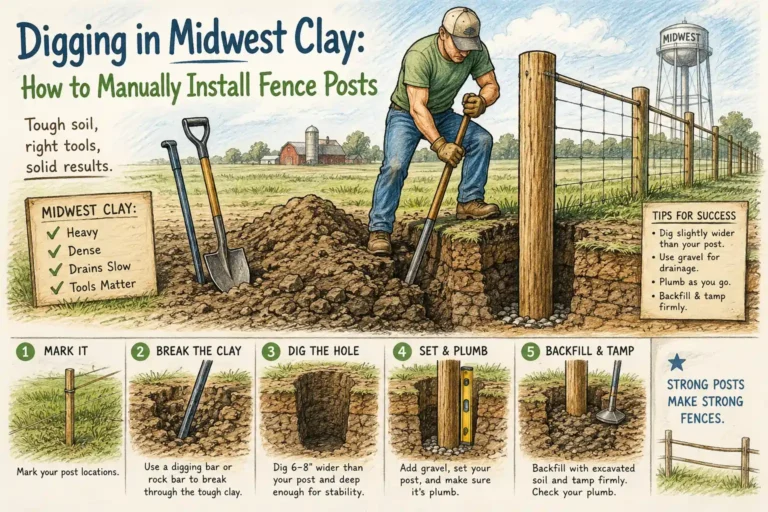
For hard-packed clay or rocky soil, standard flat shovels are ineffective. A heavy steel pickaxe or mattock is used to break up dense soil crust and loosen embedded rocks before scooping with a narrow trenching shovel. Soaking exceptionally dry, sun-baked clay soil with water the evening before digging also softens the ground, making manual spade penetration significantly easier.
Trench dimensions depend on the specific project requirements: Low-Voltage Cable / Wire: ~6 inches deep. Invisible Dog Fencing: ~3 inches deep. French Drains & Swales: ~18 inches deep and 10 to 12 inches wide. Water Supply Pipes: ~24 inches or deeper (below local frost lines).
Digging post holes requires a manual post-hole digger and a heavy steel digging bar to break through rocky subsoil. As a rule of thumb, hole depth should equal roughly one-third to one-half of the above-ground post height (e.g., a 6-foot fence post requires a 2- to 3-foot deep hole). Once dug, adding a 6-inch base of crushed stone ensures proper drainage beneath the wooden post before setting it in concrete.
Excess soil excavated from trenches or post holes can be repurposed in several ways: Use clean topsoil to fill low spots or regrade along home foundations. Build up decorative garden berms or raised planting beds. Post “free clean fill dirt” listings on local community boards (like Nextdoor or Facebook Marketplace) for nearby neighbors to haul away. Load leftover dirt into a trailer or truck bed for disposal at a local yard waste or landfill site.
Choose a service that offers clear hourly labor rates, uses proper hand tools, and respects your property. Confirm that the crew understands your specific project depth and timeline, and ensure 811 utility marks are completed before work begins. Hiring a transparent, labor-only service provides hardworking muscle to handle grueling digging tasks without paying high machinery rental markups. Click here to get a digging quote from His Workmanship.
Blogs about Hand Digging
- Inbound Developer/
- May 1, 2026/

- Inbound Developer/
- January 16, 2026/
His Workmanship is a Christian company
The mission of His Workmanship is to glorify God by displaying the gospel through speedy communication and quick scheduling. We are an online booking agency which facilitates the provision of labor services by matching Christian college providers with homeowners.
Hear what a provider says
My name is Daniel and this is my first summer helping residential homeowners through His Workmanship. I used to attend the same church as the owner so that is how I learned about this amazing opportunity. To be honest, I really enjoy finding customers through a referral company that so clearly reflects the Christian faith in their business model. The cherry on top is that a $20 discount is offered to everyone who reads a certain passage in the Bible.
The college students attend

Glenview, IL
12:10 PM,
Oct 7, 2026
 73°F
73°F
clear sky
Humidity:
60 %
Wind:
7 mph
Wind Gust:
0 mph
Clouds:
0%
Sunrise:
6:54 AM
Sunset:
6:23 PM
Weather from OpenWeatherMap
Fun facts about Glenview
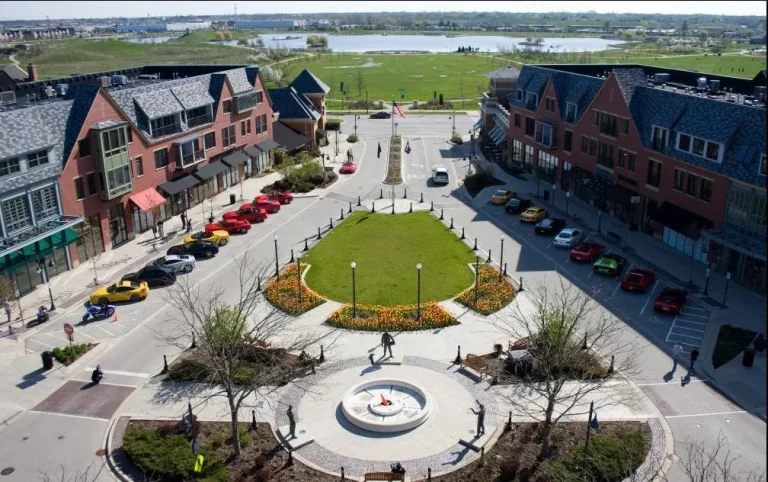
The Park Center is a prairie-style multi-purpose community center, one of the largest in Illinois, and is located in the heart of The Glen on the shores of Lake Glenview. Wagner Farm is an 18.6-acre farm owned by the Glenview Park District. Glenview’s land includes portions of the Forest Preserve of Cook County, which spans across much of the Cook County of Illinois. Naval Air Station Glenview was a major facility in Glenview for many years. The Park was established as home to a religious society in 1894 by Hugh Burnham. Learn more about Glenview schools, utilities and parks.